
How an AI agent works: A look under the bonnet of reasoning and multi-agent systems
- The difference between standard AI and intelligent reasoning
- The architecture of our multi-agent system
- How reasoning works in practice
- System prompting: the DNA of the agents
- The future: autonomous full automation
- Why 96% response quality is possible
- Conclusion: intelligence through structure
- Frequently asked questions about ai agents
- Ready for transformation? Talk to our AI experts about your potential!
While conventional AI solutions often seem like a “black box” that produces unpredictable answers, modern AI agents work completely differently. They follow structured thought processes, systematically collect information and make well-considered decisions. At octonomy, we have developed a multi-agent system that implements precisely these principles – and achieves an impressive response quality of 96%.
The difference between standard AI and intelligent reasoning
Standard AI systems often work on the principle of “one-shot answering”: they receive a query and immediately generate an answer based on probabilities. The problem? These answers can be inaccurate, incomplete or even hallucinated.
Our approach at octonomy is fundamentally different. Our AI agents go through a structured reasoning process that starts with a thorough context analysis. The agent first analyses the query and identifies the specific context before systematically navigating through relevant areas of knowledge. Instead of immediately producing an answer, the agent asks specific questions as required to gather all relevant information. Only after this complete collection of information is an informed response produced.
The architecture of our multi-agent system
Central knowledge base as the foundation
At the heart of our system is an intelligently structured knowledge base that is fed from various source systems. Documentation systems such as Confluence and SharePoint provide structured information, while manuals and technical specifications provide detailed knowledge. Workflows and process documentation provide contextual links, and transactional systems enable access to real-time information.
However, what makes our solution special is not just the data collection, but the intelligent processing. The data is not simply stored, but transformed using specialised algorithms. Intelligent chunking breaks down large documents into meaningful units, while normalisation and hierarchical provision create a context-sensitive knowledge graph. This structure enables agents to generate precise and relevant answers instead of getting lost in a sea of unstructured information.
Specialised agents for different tasks
Instead of a generic “jack of all trades”, we rely on specialised agents that are optimised for specific tasks. Support agents focus on processing customer tickets quickly and accurately, and are trained to translate complex technical problems into comprehensible solution steps.
Consultancy agents, on the other hand, are designed for comprehensive field service enquiries. They can access extensive product information and develop customised solutions that are tailored precisely to the needs of the respective customer. These agents not only understand the technical specifications, but can also explain complex relationships between different product components.
Supervisor agents act as intelligent switches in the system. They analyse incoming requests, evaluate their complexity and context and forward them to the best specialist in each case. This orchestration ensures that each enquiry is processed by the agent best suited to the specific problem.
Intelligent tool integration
Our agents are more than just chatbots – they are active system participants that can interact with the entire IT landscape. Integration with ticket systems such as Jira, ServiceNow or FreshDesk enables agents not only to answer enquiries, but also to create, update and track tickets.
Logistics systems provide real-time information on deliveries and order status, while ERP systems provide detailed customer information and order histories. One particularly innovative enhancement is the telephony integration, which makes it possible to hold natural language conversations. Customers can simply call the AI and discuss their concerns as if they were speaking to a human employee.
How reasoning works in practice
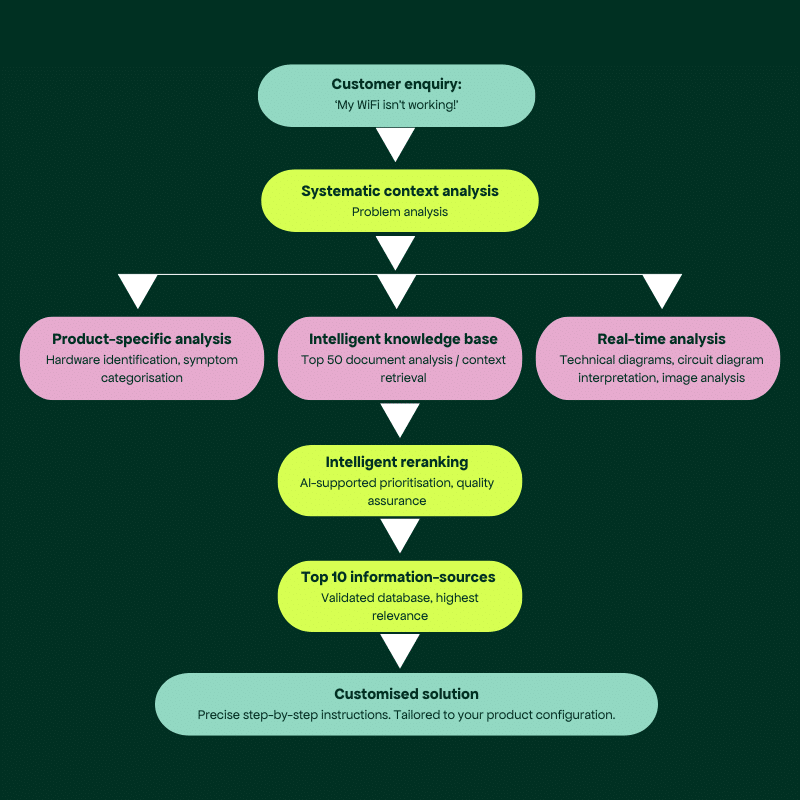
Let’s take a concrete example from our Devolo Wi-Fi support to illustrate how our reasoning approach differs from conventional AI systems.
If a customer writes “My Wi-Fi is not working properly”, a standard AI solution would typically output a generic list of troubleshooting steps. This answer may be technically correct, but often does not help to solve the specific problem.
Instead, our octonomy agent starts with a systematic contextualisation. Which specific Devolo product is the customer using? What specific symptoms are occurring? When did the problem first occur? In parallel, the agent searches the top 50 most relevant document areas in our knowledge base, utilising advanced retrieval mechanisms.
The ability to analyse images in real time is particularly impressive. If the knowledge base contains technical diagrams and schematics, the agent can interpret them and include them in its response. An intelligent reranking system then filters out the 10 most accurate sources of information based on the specific context of the enquiry.
The structured response is then a customised step-by-step guide tailored to the customer’s product configuration. If the first answer is not sufficient, the agent enters into dialogue: “Have you already carried out step X? What result did you get?” – and adapts its recommendations accordingly.
System prompting: the DNA of the agents
System prompting gives each agent a clear “personality” and way of working. These prompts not only define the agent’s behaviour, but also their limits and quality standards. A typical system prompt could read: “You act as a support AI for area X. You should strictly adhere to the manuals, not make anything up and not use forum knowledge. Be precise and follow up on any ambiguities. For complex cases, gather all relevant information before giving an answer.”
These prompts are highly specific and are carefully customised depending on the use case. An agent for quick ticket processing behaves fundamentally differently to an agent for complex consultations, even though both are based on the same technology.
The future: autonomous full automation
Our system follows a clear development strategy, which we refer to as a maturity curve. The first stage is about knowledge consolidation – the centralised provision of all relevant information in a structured form. Teams can already work much more efficiently in this way, as they no longer have to laboriously navigate through different systems.
The second stage involves assisted automation. The system generates pre-answers and assists with processing, while human experts retain final control. This phase enables teams to significantly increase their productivity without increasing the risk of errors.
The target scenario is autonomous full automation, in which the system processes standard enquiries completely independently. Complex cases are recognised intelligently and forwarded to human experts, who can then concentrate on the really challenging tasks.
Why 96% response quality is possible
The high precision of our answers is the result of a combination of several mutually reinforcing factors. Structured reasoning prevents impulsive answers and ensures well thought-out solutions. The context-sensitive knowledge base with hierarchical information structure enables the agents to find the relevant information even for complex queries.
Specialised agents for specific use cases ensure that each agent is optimally matched to its task. Continuous validation through systematic enquiries ensures that the solution really fits the problem. Integration into existing systems provides real-time information, which is essential for precise answers.
Conclusion: intelligence through structure
Modern AI agents do not “think” like humans, but they follow structured processes that lead to more reliable results than conventional AI systems. At octonomy, we have translated these principles into a practical multi-agent system that not only automates complex support processes, but also delivers exceptional quality.
The result: teams can breathe easy while productivity increases – just as our claim promises: “When your team grows without getting bigger.
Want to learn more about our multi-agent technology? Contact us for a personalised demo and experience how structured AI reasoning can revolutionise your support processes.