What is AI in Customer Service?

AI in customer service refers to the use of technologies like machine learning, natural language processing (NLP), and speech recognition to automatically understand, prioritize, and process customer inquiries.

It enables capturing requests in natural language, considering context from customer data, history, and system information, and deriving appropriate responses, workflows, or action recommendations.

Why is AI in Customer Service now indispensable?

  • Limits of classic structures
    Skilled labor shortages amid rising product complexity.
  • Decoupling capacity from quality
    Scaling without linear headcount growth.

  • Data-driven transparency
    Decisions become traceable, SLAs better met.

Use Cases

Where AI makes the difference

Omnichannel assistance

AI connects phone, email, web, and social media centrally. Virtual assistants understand inquiries across channels, recognize customers, guide through self-service processes, or hand over with full context to agents.

Automated case processing

Analysis of thousands of emails and attachments. AI extracts IDs and deadlines, categorizes cases, and creates structured tickets. Standard cases are resolved directly; complex ones prepared for humans.

Voice bots & speech analysis

Voice bots handle identification and status checks. Speech analysis detects sentiment and urgency in real-time to minimize escalations and reduce wait times.

Tech Support & ITSM

Evaluation of log data and monitoring events. AI suggests root causes and workarounds, shortens time-to-resolution, and supports field service in deployment planning.

Predictive Service

AI identifies patterns for looming failures or churn. Proactive measures like information campaigns or maintenance turn support from incident handler to shaper.

“AI acts as a scalable complement to existing service teams.”

Benefits

Measurable success for companies

Decoupling: Ticket volume vs. effort

Rising inquiry volumes no longer require proportional resources.

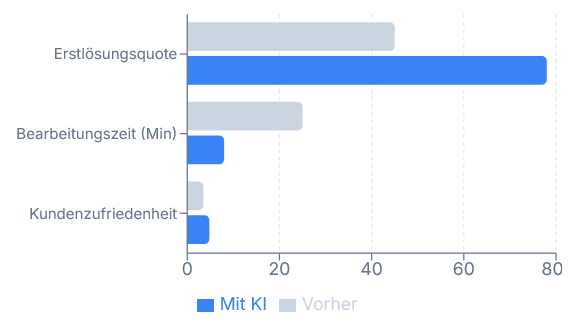
Improved service KPIs

Comparison before and after AI implementation shows faster resolutions and higher satisfaction.

Scalability

Handle high volumes without linearly expanding teams. Peak loads absorbed automatically.

Compliance

Adherence to SLAs and policies at every step. Full documentation for regulated industries.

Expert relief

AI takes routine tasks. Specialists focus on complex solutions and customer relationships.

Implementation

Integration in enterprises

Large companies work with diverse systems—CRM, ITSM, ERP, ticketing, industry software, portals, DMS, and more. Successful AI solutions integrate seamlessly via APIs and connectors, leveraging existing data sources without media breaks.

Clear targets for data flows, responsibilities, and AI’s role in processes are essential.

Security, data protection, and governance

In enterprise contexts, security, data protection, and governance are prerequisites. Companies need clear policies on data processing locations, access rights, model training and monitoring, and explainable AI decisions.

GDPR compliance, EU AI Act, role-based access, logging, audit trails, and explainable AI must be considered from the start.

Scalable architecture and MLOps

For long-term success, scalable architecture and professional MLOps are required: model versioning, automated testing, performance monitoring, retraining strategies, and structured feedback handling.

This transforms a pilot into a robust, company-wide platform for intelligent customer interactions.

Change management and team acceptance

AI introduction changes roles, processes, and workflows. Involve employees early, communicate clear benefits, and offer training on how AI supports daily work.

Teams should experience AI as relieving routine, reducing errors, and strengthening them in complex cases—not as replacement.

Path to success

In 5 steps to an AI-supported service organization

2

As-is analysis & use cases

Identify high volumes and bottlenecks. Define entry points like password resets or status queries.

Evaluate data landscape

Capture relevant sources and systems. Clarify interfaces and compliance needs.

Pilot with clear KPIs

Select focused use case. Measure goals like reduced processing time.

Optimization & expansion

Analyze tickets, expand knowledge bases, refine handovers to agents.

Scaling & rollout

Extend to more channels, countries, languages—on stable architecture.

FAQ: Common Questions on AI in Enterprise Customer Service

Primarily for large enterprises and corporations with high inquiry volumes, complex processes, multiple locations, or regulated environments, AI in customer service pays off quickly. The more channels, products, and stakeholders involved, the greater the scaling and efficiency gains.

No. AI primarily handles recurring, standardizable tasks, structures information, and supports decision-making. Human employees remain essential for complex, emotional, or negotiation-intensive cases and benefit from having more time for high-quality interactions.

With a clearly defined use case and available data, initial prototypes and pilots can often be implemented within a few weeks. Measurable effects like reduced processing times or higher self-service rates typically emerge after a few months, once models are optimized with real data.

Data protection and regulation are central success factors in enterprise environments. Companies should clarify early which data is processed, where it is stored, how long it is retained, and how data subjects are informed. The EU AI Act adds requirements for transparency, risk assessment, and governance that should be considered when conceiving and selecting AI solutions.

The best starting point depends on volume, pain points, and system landscape. Web or portal chatbots and email/ticket automation often provide a strong foundation, as they deliver quick visible effects and are relatively easy to integrate. Phone and voice solutions typically follow in the next phase, once processes and data foundations are established.

A continuous optimization process is key: employee feedback, analysis of real dialogues, regular model training, and a well-maintained knowledge base. Clear guidelines (tone of voice, escalation rules, permitted actions) ensure AI operates within brand and service goals.